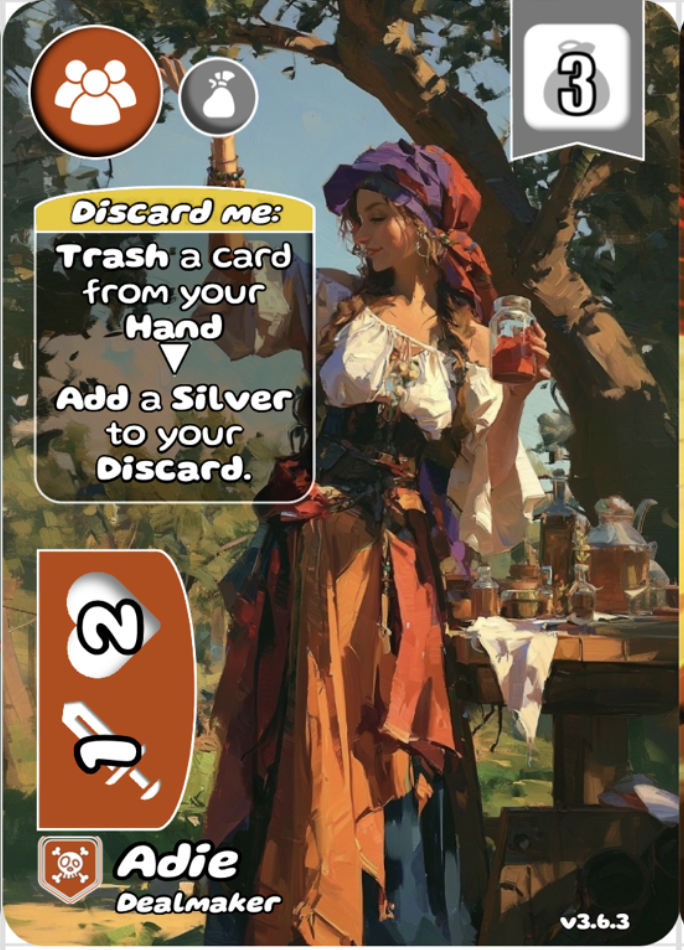
Complete a Region’s Quest to take control of it for the rest of the game. Every Quest you complete pays you 2 Goods toward Recognition () each turn while your Stack there has cards.
Gig Harbour
QUEST8 Damage () in this Stack.
Atos
QUEST3 Tactics () across your Stacks.
Ios
QUEST8 Health () in this Stack.
Pinehurst
QUEST8 cards in your Hand.
Mangan’s Landing
QUESTA Citizen (), a Structure () and a Tactic in this Stack.
01 — REGIONS
Stack cards in five Regions.
Each new card covers the abilities of the one before it. Where you build, and what you leave exposed, decides the board.
02 — DECK
Build your deck as you play.
Buy from the Market with Goods (), trash () the cards you have outgrown, and climb your Hero’s Skill Tree.
03 — SCORE
Most Recognition wins.
Score your Recognition cards, each Region you are in, each Region you control, and every checkered flag () left exposed.
THE TURN
Five phases, every turn.
PHASE 1HeroResolve your Skill Tree, collect from the Regions you control, and swap cards with your Pocket.
PHASE 2PurchaseBuy from the Market with the Goods in your Hand.
PHASE 3PositionPlace Citizens and Structures into your Stacks.
PHASE 4ContestPlay Tactics onto your Stacks, or use them from your Hand.
PHASE 5Damage & Clean UpOpposing Stacks trade Damage, and destroyed cards and Tactics are discarded together.
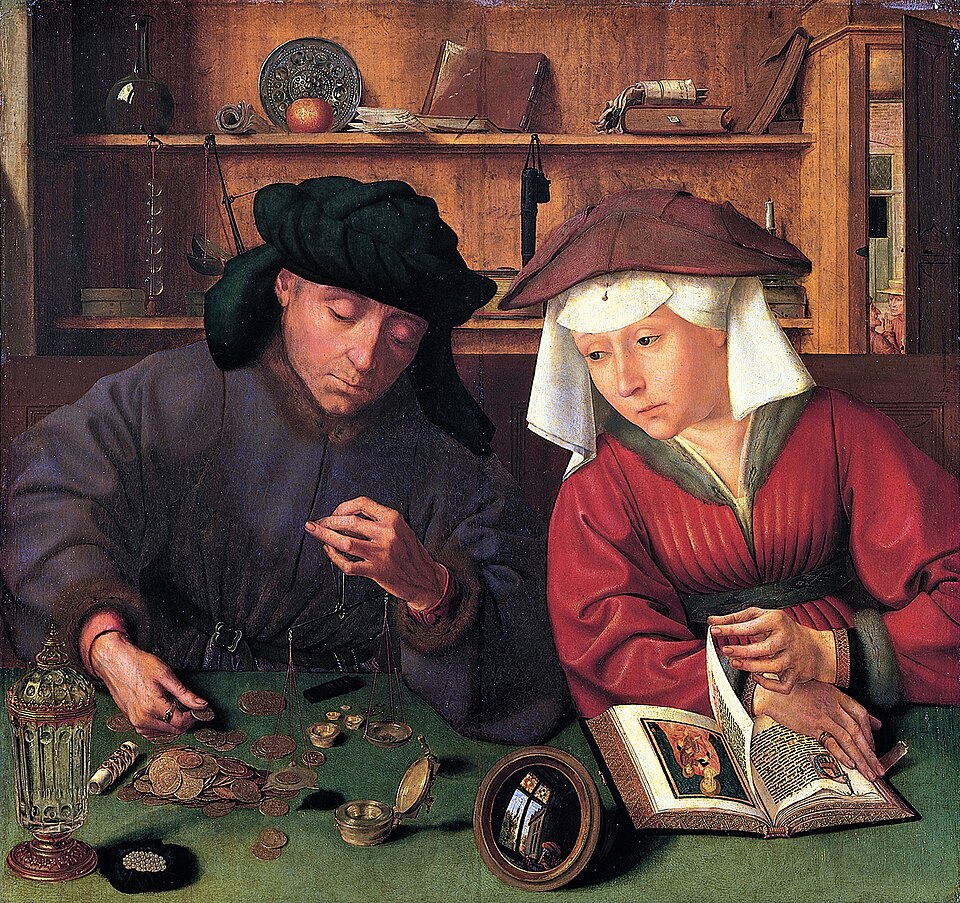
The Moneylender and His Wife (1514) — Quentin Matsys
THE CENTRAL TENSION
Play it, or spend it.
Every card in your Hand has up to 3 uses.
1
Spend it
Its Goods value pays for cards at the Market.
2
Use it
Play its Hand ability, then Discard or Trash it.
3
Stack it
Place it in a Region. Its Stack abilities work while it is exposed.
A NOTE FROM THE DESIGNER
I started Mangan’s Landing because I wanted a deckbuilder my friends and I could finish on a weeknight and still argue about on the walk home.
It’s at build v3.6.2 now. The maths works, and the art has started arriving — the cards on this site are real illustration from artists I’ve been lucky to work with. There’s a lot still to commission, and that’s a big part of what the campaign is for.
If you want to watch it get made, or help make it: the list is the best place to be. If you want to play it, come to a Partiful night. I’ll bring the box.
You play as a Hero (). Over the game you buy cards, place them at five Regions and complete Region Quests to earn Recognition (). The player with the most Recognition when the game ends wins.
Each turn you buy cards from a shared Market, place Citizens () and Structures () in your Stacks at the Regions, and play Tactics () that add Damage () or Shields (). At the end of each turn, each Stack deals its Damage to the opposing Stack at the same Region.
5 Region cards. The Region cards lie in a row between the players, Quest side up, with the Market at one end. Each Region holds one Stack for each player. When a player completes a Region’s Quest, that Region card flips to its Reward side and stays that way for the rest of the game.
1 Hero card per player. Each Hero card has a Skill Tree with 6 Levels, from Level 0 to Level 5. Each Hero also has a starting deck of 8 cards, and each of these cards shows that Hero’s mark in a corner:
Susie Kenzie
Seamus
Edith Savo
Finn Maguire
Pocket Cards (). Each player starts with 1 Goods () card face down in their Pocket. Only you may look at the cards in your Pocket. Cards you buy go to your Pocket (§4.2).
6 standing piles of cards that are always for sale. Each pile holds one card and has a fixed cost: 0, Aim 2, Worker 2, Silver 3, Shop 4 and 5. Goods starts with 12 cards; Aim, Worker, Silver and Shop start with 5 each; Recognition starts with 10. Standing piles are never shuffled.
The Market Deck. About 40 cards, shuffled and placed face down beside the standing piles. It deals new cards onto the 4 Market Piles.
The Market Discard. A shared, face-up pile. Trashed () cards go here (§8.2). They return to play when the Market Deck is rebuilt (§8.3).
The player with the most when the game ends wins. You score Recognition in four ways (scoring is explained in full in §9):
1 for each card you own, in any zone (e.g., your Deck, Hand (), Discard, or a Stack).
1 for each Region where your Stack has at least 1 card.
1 for each Quest you have completed, if your Stack at that Region still has at least 1 card.
The points on each Finish () ability that is active when the game ends (§6.4).
2. Key terms
These terms have exact meanings in this rulebook. Each one is written with a capital letter.
Region
One of the 5 location cards between the players. Each Region holds one Stack per player. Each Region card prints a Quest and the phase in which that Quest is checked.
Stack
All of your cards at one Region. Cards are laid sideways and overlap, starting at the Region and growing toward you. Citizens (), Structures () and Tactics () are placed in Stacks; Supplies () with a Stack ability can be too (§4.2).
Exposed
A card is exposed when no card is behind it in its Stack (e.g., the card farthest from the Region). This is usually the card placed most recently. Only the exposed card’s Stack abilities work (those in a grey box), except abilities printed in a white box (§6.4).
Hero and Level ()
Your Hero card and its Skill Tree. Your Level is the number of Regions where your Stack has at least 1 card, from 0 to 5. Levels are recounted only during Clean Up (§4.5).
Pocket ()
A face-down pile that only you may look at. Cards you buy go here. You can move cards between your and your Hand () only during your Hero phase. Your Pocket holds 1 card, plus any extra space given by cards in play, and it must always hold at least 1 card. You start with 1 Goods () in it.
Goods ()
The unit used to pay costs. Each card shows the it pays when you spend it (e.g., a Goods card pays 1). Goods given by abilities go into your bank and can be spent until the end of that turn’s Purchase phase.
Supplies ()
The card type used mainly to pay (e.g., ). are not placed in Stacks, except Supplies with a Stack ability (e.g., Silver), which can be added to a Stack during the Purchase phase (§4.2).
Citizen ()
A card with Damage () and Health () that is placed in a Stack during the Position phase (e.g., Worker).
Structure ()
A card with and that is placed in a Stack during the Position phase. usually have more Health than , and most have an ability.
Tactic ()
A card that is placed in a Stack only during the Contest phase. Its counts toward that turn’s Damage step. Its Shields () are its . Every is discarded during Clean Up.
Recognition ()
The card that scores points. It costs 5 and is worth 1 point. During the Purchase phase it can be spent as 1 , but only toward buying another . The Market starts with 10. When the pile is empty, the game ends at the end of that turn (§9.1).
Quest and control
A Region’s Quest is a condition (e.g., 8+ in this Stack). If you meet it during the phase named on the Region card, you complete it, and the Region card moves to the front of your Stack for the rest of the game. A completed Quest never resets (§5.4).
Priority Player
The player who acts first in every phase of a turn. On the first turn, each player rolls one die and the highest roll takes Priority. After that, Priority passes to the other player every turn.
Trash and Discard ()
A Discarded card goes to your own Discard pile and comes back when you shuffle your Discard into a new Deck. A card leaves your cards for good: it goes back to its standing pile, or to the Market Discard if it has no standing pile (§8.2).
3. Setup
For 2 to 4 players. Setup takes about 5 minutes.
Lay out the Regions. Place the 5 Region cards in a row, Quest side up, with the Market at one end. Leave space on each player’s side of every Region for that player’s Stack.
Choose Heroes. Choose Heroes at random, by draft or by agreement. Each player takes the 8 cards with their Hero’s mark and shuffles them face down to form their Deck. Place your Hero card at the far left of your play area and your Deck at the far right, with space beside it for your Discard. Every player starts at Level 0 with no cards in Hand ().
Take a Pocket Card (). Each player takes 1 card from the Goods () pile and places it face down and sideways across their Hero card. This is your Pocket Card. Its position on the Hero card marks your Level. Only you may look at it.
Set out the standing piles. Place them beside the Market in order of cost: 0, Aim 2, Worker 2, Silver 3, Shop 4, Recognition () 5. The Recognition pile holds 10 cards.
Deal the Market Piles. Shuffle the Market Deck and place 1 card face up on each of the 4 Market Piles.
Decide Priority. Each player rolls one die. The highest roll takes Priority for the first turn; players who tie roll again. Priority then passes to the other player every turn.
Opponent
Discard
Deck
Hero
Pocket
Their Stack
Their Stack
Their Stack
Their Stack
Their Stack
Gig Harbour
Atos
Mangan’s Landing
Ios
Pinehurst
Your Stack
Your Stack
Your Stack
Your Stack
Your Stack
You
Hero
Pocket
Deck
Discard
Market
Mkt Discard
Goods 0
Mkt Deck
Aim 2
Pile 1
Worker 2
Pile 2
Silver 3
Pile 3
Shop 4
Pile 4
Recog. 5
A two-player table. The Market’s cards lie sideways with their bottoms (the thick edge) toward the Regions, so both players can read them: Market Discard, Market Deck and the four Market Piles nearest the Regions, the six standing piles behind them in ascending cost. Your Pocket Card lies face down across your Hero card and slides along it to mark your Level. Your Hero card sits at the far left of your play area and your Deck and Discard at the far right, leaving the middle open. Your Stacks grow from the Regions toward you.
Note
No one draws cards during setup. You draw your first 4 cards from Level 0 of your Skill Tree in the first Hero phase.
4. The turn
Each turn has 5 phases, in this order: Hero, Purchase, Position, Contest, and Damage & Clean Up. In each of the first 4 phases, the Priority Player acts first, then the other player. Both players must finish a phase before the next phase begins.
Resolve your Skill Tree in order, from Level 0 up to your current Level (e.g., at Level 2, resolve Level 0, then Level 1, then Level 2). Level 0 always draws 4 cards. Levels above your current Level do nothing.
Next, resolve the Hero-phase abilities on cards in your Stacks. Start with the Stack nearest the Market and work away from it; within a Stack, go from front to back. An ability resolves only if its card is exposed or the ability is in a white box.
A completed Quest’s Region card is part of its Stack, so its reward resolves in the same order: put 2 Goods () in your bank. These Goods can be spent only on Recognition (), and only in this turn’s Purchase phase. If your Stack at that Region has no other card, the reward does nothing.
You may use “Discard me” abilities from your Hand () (§6.3).
You cannot play cards or use abilities from your Hand in this phase. The phase runs in order: your hero’s skill tree, then the Hero abilities on your Stacks, then the Pocket () swap.
You may move any number of cards between your and your . This is the only phase in which you can do this.
Your holds 1 card, plus any extra space given by cards in play, and must always hold at least 1 card, face down. You start with 1 in it. The limit is checked at the end of this phase (e.g., with a limit of 1, exactly 1 card must be in your Pocket when the phase ends).
You may move a card from your into your only while the Pocket has room, so you can never put it over its limit. It goes over only when you buy cards or an ability puts cards in it; if you open an over-full Pocket, move cards to your Hand until it fits before you close it (e.g., with a limit of 6 you may fill it to 6 for Pinehurst).
Quests marked Hero are checked during this phase (e.g., Kingdom of Ios).
Draw abilities are written “+N” (e.g., +2 means draw 2 cards). If your Deck runs out while you are drawing, shuffle your Discard to make a new Deck and keep drawing.
Note
Your Level changes only during Clean Up. It stays the same for the whole turn, even if you gain or lose cards in your Stacks during the turn.
Buy any number of cards, including none. You can buy from the 6 standing piles or the top card of any of the 4 Market Piles. Buying the top card of a Market Pile exposes the card under it, which can then be bought.
To pay a cost, spend cards from your and from your bank. Each card you spend pays its printed Goods value and goes to your Discard. If you pay more than the cost, the extra Goods stay in your bank until the end of this phase (e.g., paying 3 for a card that costs 2 leaves 1 Goods to spend on another card).
You may use Purchase-phase abilities on exposed cards and “Discard me” abilities from your . in your bank keep any limit they came with (e.g., extra Goods from a card that pays only toward Tactics () can be spent only on Tactics).
Some abilities have a cost in restricted (e.g., Ios Windmill: pay 4 Goods toward ). Pay it with Goods restricted to that type, unrestricted Goods, or both.
Any Supplies () with a Stack ability (e.g., Silver, Astral Gemstone, Humour Ink, Thistle, Day Labor, Map to Riches) can be added from your to one of your Stacks instead of being spent. In a Stack, a Supplies has no Health () and cannot be Damaged. A Supplies with Damage () adds it to its Stack. A Supplies’ Shields () soak Contest Damage like a Tactic’, but the card is not Discarded when they run out. Each one carries a Static () ability: if it is exposed and its Stack has no Citizen () or Structure (), it is Discarded (e.g., if the only Citizen in its Stack is destroyed during Clean Up, the Supplies is Discarded once the Tactics behind it leave).
You may spend a from your as 1 , but only toward buying another Recognition. It goes to your Discard and still scores at the end.
Cards you buy go to your and stay there until your next Hero phase. You cannot move cards from your to your Pocket in this phase.
Quests marked Purchase are checked during this phase (e.g., Pinehurst).
Note
Some cards let you Trash () cards from your or Discard. A smaller deck draws your strongest cards more often. The Priority Player buys first, so they have the first choice of the Market.
Resolve the Position-phase abilities on your exposed cards.
Place any number of and from your into your Stacks. You may split them across the 5 Regions in any way.
Place each card sideways, behind the last card in the Stack, so its combat box reads upright. The new card covers the ability boxes of the card in front of it and becomes the exposed card. The covered card’s combat box stays in play.
A Reveal () ability resolves when its card is placed. It resolves again each time the card becomes exposed after being covered (e.g., when the card behind it is destroyed).
You cannot return a placed card to your . An ability can still move it (e.g., “You may Move me to another Stack”).
In Priority order, each player places any number of from their into their Stacks, or uses “Discard me” abilities from their Hand.
A Tactic’ adds to its Stack’s total for this turn’s Damage step only. Its are its . Like any card, it takes Damage in Stack order, so it protects only the cards behind it (e.g., a Tactic at the back of a Stack is hit last and protects nothing) (§7.1).
Quests marked Contest are checked during this phase (e.g., Gig Harbour, Kingdom of Atos and Mangan’s Landing).
When both players have finished, the turn moves to Damage & Clean Up. No Contest is dealt before then.
Neither player makes choices in this phase, except to resolve abilities (see below). Do steps 1 and 2 at one Region at a time, starting with the Region nearest the Market. Then do steps 3 to 6 once.
Each Stack deals its total to the opposing Stack at the same Region, starting with that Stack’s front card (§7.1).
Discard every destroyed card and every from both Stacks at that Region, all at the same time.
Recount every player’s Level.
Place 1 new card from the Market Deck face up on top of each of the 4 Market Piles.
Every player Discards all cards in their .
Check whether the game ends. It ends now if the pile is empty, the Market Deck has run out for the second time, or every Region’s Quest has been completed (§9).
during step 2. Removing cards can expose a card with a Reveal ability. Its owner resolves that Reveal right away, before is dealt at the next Region. If both players have a Reveal to resolve at the same Region, the Priority Player resolves first. If that Reveal destroys the other player’s card, the other player still resolves their Reveal.
Note
Your is Discarded at the end of every turn. To keep a card for a later turn, move it to your during your Hero phase. There is no Hand size limit.
Presence and control are different, and each one scores separately.
Presence: your Stack at a Region has at least 1 card. Each Region where you have presence adds 1 to your Level and scores 1 point at the end.
Control: you completed that Region’s Quest, so its Region card is at the front of your Stack. Control lasts for the rest of the game. A completed Quest never resets, and no other player can complete it.
Control does not stop other players from placing cards at that Region. If your Stack there has no other card, the Region card’s abilities stop working until you place a card in that Stack again (e.g., no 2 Goods () in your Hero phase, and no point if the game ends while it is empty).
Your Level is the number of Regions where your Stack has at least 1 card, from 0 to 5. It is recounted during Clean Up and stays the same for the whole next turn. Players can be at the same Level.
Level 0 is the same for every Hero: draw 4 cards. It always resolves. The higher Levels differ by Hero. Each Hero’s Skill Tree is printed on their Hero card. Reaching Level 5 does not end the game.
Note
One Citizen () placed at a Region where you have no cards raises your Level by 1 at the next Clean Up, if it survives. Spreading cards across Regions raises your Level. Putting many cards in one Stack deals more Damage () at that Region.
, Structures () and Tactics () are placed in Stacks. Supplies () are not, with one exception: a Supplies with a Stack ability (e.g., Silver) can be added to a Stack during the Purchase phase (§4.2). Other Supplies are spent from your Hand () and go to your Discard.
Cards are placed one at a time, sideways. The first card is at the front, next to the Region. Each new card goes behind the last one and becomes the exposed card.
A Stack ability works only while its card is exposed, unless the ability is in a white box.
Combat boxes are never covered. The and Health () of every card in a Stack always count.
A Stack has no size limit. A card leaves a Stack only when it is destroyed, or moved or Discarded by an ability. Every leaves during Clean Up.
If the card behind a card is removed, that card becomes exposed again and its abilities work again. Its Reveal () ability resolves again (§6.4).
Each Region card prints a Quest and the phase in which it is checked. You complete a Quest when all three of these are true at the same time: (1) it is the phase named on the Region card, (2) your Stack at that Region has at least 1 or , and (3) you meet the Quest’s condition.
Gig Harbour5+ Citizens in this Stack · Hero
Kingdom of Atos3+ Tactics in this Stack · Contest
Mangan’s LandingAt least 1 Citizen, 1 Structure, 1 Tactic and 1 Supplies in this Stack (e.g., a Silver added during the Purchase phase) · Contest
Pinehurst4+ Supplies in this Stack · Hero
Kingdom of Ios5+ Structures in this Stack · Hero
When you complete a Quest, the Region card flips to its Reward side and moves to the front of your Stack. It stays there for the rest of the game, even if your Stack becomes empty. The Reward side has three abilities. (1) Purchase phase, white box: put 2 in your bank that can be spent only on Recognition (). (2) Grey Static (): “As long as this is , my Abilities don’t Trigger.” It stays on for as long as the Region card is exposed (e.g., while your Stack has no other card), and the other two abilities do not work. Place a card behind it to turn it off. (3) Finish (), white box: 1 point at the end of the game. If both players meet the same Quest in the same phase, the Priority Player completes it.
A completed Quest never resets. When every Region’s Quest has been completed, the game ends at the end of that turn (§9).
The icon in the top-left corner shows the card’s type: Supplies (), Citizen (), Structure (), Tactic () or Recognition ().
The badge in the top-right corner shows its cost in Goods ().
The combat box shows the card’s Damage () and Health (). The Health icon depends on the card type (e.g., a heart on , a mark on Structures, Shields () on ), but all Health works the same way. A with Damage or Shields shows them the same way.
Each ability box is colored by the phase in which it is used.
When a card is covered in a Stack, its colored ability boxes stop working. Its combat box and any white-box ability keep working.
123456789
Type: here, a .
value: what the card is worth when you spend it.
Cost, paid in .
Ability box, tinted by when it is used. “Discard me” is played from your Hand ().
abilities are used from your Hand during any phase of your own turn, except the Hero phase and Damage & Clean Up. To use a “Discard me” ability, put the card in your Discard. To use a Trash () ability, Trash the card instead (§8.2), so it leaves your cards for good.
Stack abilities work only while the card is in a Stack and exposed, or at any time in a Stack if the ability is in a white box. Each is used in the phase its color shows.
A card can have both kinds. You can use only the abilities that match where the card is now (e.g., a card in your cannot use its Stack ability). When two Hand abilities are joined by “or”, choose one.
Reveal. Resolves when its card is placed in a Stack, and again each time the card becomes exposed after being covered. It does not resolve again while the card stays exposed.
Static. Always on while its card is exposed, or always on if it is in a white box. It does not resolve; it changes a rule while it applies (e.g., Duncan: all Supplies in front of me get +1 Damage and +1 Shield).
Finish, the checkered flag. Scores when the game ends, but only if its card is exposed in a Stack or the ability is in a white box. A Finish ability on a card in your Deck, Hand, Discard or Pocket scores nothing.
Trash. The card goes to its standing pile, or to the Market Discard, instead of your Discard (§8.2).
White box. A Stack ability that is never covered. It keeps working wherever its card is in a Stack, even with cards behind it.
Grey box. A Stack ability that is covered by cards behind it. It works only while its card is exposed.
May. An ability with “may” is optional. An ability without “may” must resolve if it can.
Requirements. Some abilities need a minimum count before they work (e.g., “If you have at least 2 Tactics among your Stacks”). If the count is not met when the ability resolves, it does nothing.
Note
An ability box that is not covered can be used. Its color shows the phase. A white box works even when covered.
Add up the Damage () of every card in your Stack, Tactics () included. This is your Stack’s total Damage.
Assign that total to the opposing Stack at the same Region, starting with its front card (the card nearest the Region) and moving back.
A card is destroyed when the assigned to it equals or exceeds its Health (). Damage left over moves to the next card behind it, whatever its type, until the Damage runs out or every card is destroyed (e.g., 3 Damage against a front card with 2 Health and a back card with 1 Health destroys both).
Both Stacks deal at the same time. A card that is destroyed still deals its Damage this turn.
left over after every card in the opposing Stack is destroyed is lost. Regions cannot be Damaged, and Damage never moves to another Region.
does not stay on cards. Cards that survive have full again on the next turn.
Some abilities deal directly to one card (e.g., “Deal 2 Damage to any card”). This Damage is applied right away. It destroys the card if the total Damage on it equals or exceeds its , and it never moves to the card behind. If the card is not destroyed, the Damage is removed at the end of the phase, so Contest Damage is always assigned to cards at full Health. Damage dealt by a Reveal () during Damage & Clean Up is removed at the start of the next Hero phase.
Seamus and Finn both have Stacks at Pinehurst and at the Kingdom of Atos.
1Setup
Seamus
Lyla01
Izzy & Bren12
Deals 0
Pinehurst
Deals 0
Cassian22
Ja’Rae11
Finn
Front cards sit nearest the Region.
2Total the Damage
Seamus
Lyla01
Izzy & Bren12
Deals 1
Pinehurst
Deals 3
Cassian22
Ja’Rae11
Finn
Seamus deals 1. Finn deals 2 + 1 = 3.
3Assign front to back
Seamus
Lyla01−1
Izzy & Bren12−2
Deals 0
Pinehurst
Deals 0
Cassian22−1
Ja’Rae11
Finn
Finn’s 3 destroys Izzy & Bren, and 1 carries to Lyla. Seamus’s 1 is not enough for Cassian.
4Result
Seamus
Empty
Deals 0
Pinehurst
Deals 0
Cassian22
Ja’Rae11
Finn
Seamus’s Stack is empty. Finn’s Stack is whole again.
Finn’s 3 hits Izzy & Bren (2 ) and destroys them; the spare 1 carries to Lyla (1 Health) and destroys her too. Seamus’s Stack is empty.
Seamus’s 1 hits Cassian (2 ) and is not enough. Nothing carries over, so Ja’Rae is untouched.
At the Kingdom of Atos, Seamus’s Jarl (1 , 2 ) faces Finn’s lone Worker (1 Damage, 1 Health). Jarl survives; the Worker is destroyed.
After step 2 of Clean Up, Seamus has no card left at Pinehurst and Finn has no card left at the Kingdom of Atos. When Levels are recounted in step 3, each player’s Level goes down by 1.
You start with your Hero’s 8 cards. Every card you spend, play from your Hand () or lose from a Stack goes to your Discard. When you need to draw and your Deck is empty, shuffle your Discard to make a new Deck. Every card you own comes back this way unless it is Trashed ().
A card leaves your cards for good. A card that belongs to a standing pile (e.g., Goods () or Aim) goes back to that pile. Any other card goes face up to the Market Discard and returns to play when the Market Deck is rebuilt (§8.3). Trashing is different from Discarding: a Discarded card stays yours.
Six standing piles, in order of cost: 0, Aim 2, Worker 2, Silver 3, Shop 4, Recognition () 5. Goods starts with 12 cards, Recognition with 10 and the others with 5 each. A pile can run out. You cannot buy from an empty pile until a card returns to it.
Four Market Piles. During every Clean Up, each pile gets 1 new face-up card from the Market Deck, placed on top of any card left there. Only the top card of a pile can be bought, unless a card says otherwise (e.g., Canal Street). Buying the top card exposes the card under it.
If the Market Deck does not have enough cards to add 1 to every Market Pile during Clean Up, rebuild it: shuffle the Market Piles, the rest of the Market Deck and the Market Discard together into a new Market Deck. Starting-deck cards in the new Market Deck cost 1. The Market Deck can be rebuilt only once. If it runs short a second time, the game ends (§9.1).
If the pile is empty during Clean Up, the game ends (§9.1).
Costs are paid in . Each card you spend from your pays the Goods value printed on it and goes to your Discard. Abilities can also put Goods in your bank. Some cards pay more toward one type of card (e.g., Humour Ink pays 2 toward a Tactic () and 1 toward anything else), so a card’s value can depend on what you buy. Overpayment stays in your bank until the end of the Purchase phase and keeps any limit it came with (e.g., extra Goods from a card that pays only toward Tactics can be spent only on Tactics). Goods left in your bank when the Purchase phase ends are lost. Cards left in your Hand are Discarded during Clean Up.
The game ends during Clean Up, at the end of the turn, if any of these is true: (1) the Recognition () pile is empty; (2) the Market Deck has run out for the second time (§8.3); or (3) every Region’s Quest has been completed (§5.4). Always finish the current turn before scoring (e.g., if the last Recognition is bought in the Purchase phase, play the Position, Contest and Damage & Clean Up phases first).
1 point for each Recognition card you own, in any zone (your Deck, Hand, Discard, Pocket or a Stack).
1 point for each Region where your Stack has at least 1 card.
1 point for each Quest you have completed, if your Stack at that Region still has at least 1 other card.
1 point for each Finish () ability on a card that is exposed in one of your Stacks, or printed in a white box. If a Finish ability prints a different number, score that number instead.
If two or more players have the same highest total, the game is a tie. There are no tiebreakers.
10. Quick reference
Front
Mangan’s Landing
PHASES OF THE TURN
Four phases, then Damage & Clean Up. Both players complete a phase before either begins the next. Within a phase the Priority Player acts first, and Priority alternates each turn.
1Hero
Resolve your Skill Tree in order, from Level 0 up to your current Level. Level 0 always draws 4 cards.
Then resolve the Hero abilities on cards in your Stacks.
Move any number of cards between your Pocket and your Hand.
Hero Quests are checked in this phase.
2Purchase
Buy any number of Market cards, including none.
Cost is paid in Goods icons () printed on your cards. Overpayment stays available for the rest of this phase.
“Discard me” abilities may be used in any phase of your turn except the Hero phase.
Purchased cards go to your Pocket and wait there until your next Hero phase. Your Pocket holds one card, plus any increase granted by cards in play; at least one card must stay in it, face down.
Purchase Quests are checked in this phase.
3Position
Place Citizens () and Structures () from your Hand onto your Stacks, any number, divided across the five Regions as you choose.
Lay each card sideways (landscape) so its combat boxes read upright.
4Contest
Play Tactics () onto your Stacks, sideways, or use their “Discard me” abilities.
A ’s Damage () counts toward that Region for this Contest only. Its Shields () are its Health.
Contest Quests are checked in this phase.
5Damage & Clean UpNeither player acts. Resolve one Region at a time, starting nearest the Market.
1 Each Stack deals its total Damage () to the opposing Stack, front card first
2 Discard every destroyed card and all at once. Resolve any Reveals this uncovers, Priority Player first, before the next Region
3 Recount both Hero Levels
4 Refill each Market Pile to one face-up card
5 Discard both Hands
6 Check for the end of the game (see Scoring on the back)
Back
The five card types
Supplies .
Money. Pay with the value printed on it.
Citizens .
Bodies, with and Health (). A Citizen can hold a Region.
Structures .
Harder to destroy than Citizens, and most carry an ability.
Tactics .
Contest phase only. Their Shields absorb Damage for the cards behind them. All are discarded during Clean Up.
Recognition .
Costs 5. Each one is worth 1 point, and can be spent as 1 Goods toward another Recognition.
Ability marks
Reveal. Triggers whenever the ability becomes visible: when the card is played, and when it sits at the back of the Stack. It triggers again only after being covered and uncovered.
Finish. Triggers when the game ends, only if the card is exposed at the back of the Stack.
Trash. Used from your Hand, the card goes to the Market Discard instead of your own.
A “Discard me” ability means you discard that card from your Hand to use its ability.
Region Quests
Meet a Quest during the phase named on its banner, with at least one card of your own in that Stack, and the Region card flips to the front of your Stack for the rest of the game. Nobody else can complete it, and it does not stop your opponent playing there. While your Stack there has a card, it gives 2 Goods to spend only on in each of your Purchase phases, and it is worth 1 point at the end.
Gig Harbour8+ in this Stack
Kingdom of Atos3+ in this Stack
Mangan’s Landing, , and in this Stack
Pinehurst6+ cards in your Pocket
Kingdom of Ios8+ in this Stack
HeroPurchaseContest
Your Hero Level is the number of Regions you have at least one card in, recounted during Clean Up.
Setting up
Lay the five Region cards in a row (Quest-side up), with the Market at one end.
Each player chooses a Hero, shuffles their eight starting cards into a Deck and starts at Level 0.
Each player takes one Goods card as their face-down Pocket Card.
Shuffle the Market Deck and flip one card onto each of the four Market Piles.
Set the standing piles beside the Market. Goods costs 0, Aim 2, Worker 2, Silver 3, Shop 4, 5. Ten are in play.
Decide who takes Priority. Both Hands start empty; Level 0 draws four cards in the first Hero phase.
Scoring
The game ends at the end of the turn in which the pile empties, the Market Deck runs out for the second time, or the last Quest is completed. Most points wins.
1 point for each card you own, wherever it is.
1 point for each Region you have a card in.
1 point for each Quest you have completed, while its Stack still has a card.
1 point for each checkered flag showing on a card exposed at the back of one of your Stacks.
No rule matches that. Try a card name, a phase, or a term like “Pocket”.
Patch Notes
{{ summary }}
{{ hitLabel }}
Loading patch notes…
{{ patchLoader }}
The patch notes could not be loaded just now. Please refresh, or email manganslanding@gmail.com if it keeps happening.
Dev diaries from the workbench: what changed, what we learned at the table, and where to come and play. Every issue that went out by email, newest first.
— Whether you asked for a playtest seat, and the ZIP code or city you optionally gave so I can tell where sessions are worth organizing.
— For team applications: your name, the role you’re interested in, any links you share, and your message.
— A record of when you subscribed, which page you did it on, and the fact that you ticked the consent and age boxes.
— If you play online: a record of each game — when it started, how long it ran, the heroes, the scores, the cards bought and how the game ended — recorded automatically as the game finishes, so I can balance the build. It is kept against the address you signed in with, or against an anonymous id for this browser if you did not sign in.
— If you send a bug report from the game: your note, a record of that game’s last few hundred moves and any errors it hit, the game and build version, and your browser’s name and version. If the game crashed before you could send it, the record waits in your browser until your next visit, when you can send it or discard it.
— If the game hits an error while you play: the same record, without a note, sent automatically so the fault can be fixed. At most three per game. It carries your sign-in address, or the anonymous id for this browser.
There are no analytics, no advertising trackers, and no cookies set by this site.
What your browser keeps
The online board saves a few things in your browser’s own storage (local storage), so it works the way you left it. Nothing in it is used for advertising or shared with anyone, and none of it is a cookie:
— Your sign-in, so you stay signed in for 30 days.
— Your settings: sound, music and volume, Auto Pass, side panels, text and icon size, hero tile size, your country flag and signature, recent emotes, and whether you finished the tutorial.
— An anonymous id for this browser, used to tell your recorded games apart if you play without signing in.
— A game record waiting to be sent, if a game finished or crashed while you were offline.
— A copy of the patch notes, so the page opens quickly.
Clearing your browser’s site data removes all of it. Fonts are served from this site, not from Google. If you choose Continue with Google, Google’s sign-in button loads from Google and Google’s own privacy policy applies to it.
What I do with it
I send development updates and Kickstarter news, roughly once or twice a month, and occasional playtest invitations. If you asked for the print-and-play files, I use your address to send them and to tell you when they’re updated. That’s all. I do not sell, rent, trade, or share your information with anyone, and I don’t use it to target advertising.
Where it’s kept
In a private Google Sheet that only I can open. It is not published and not shared with collaborators.
Age
This site is not intended for anyone under 16, and every form asks you to confirm you are at least 16 before submitting. If you believe a child has given me their address, email me and I will delete it immediately.
Getting removed
Every email I send has an unsubscribe link at the bottom; one click removes you and I don’t email you again. You can also write to me at the address below and ask to be deleted, or ask for a copy of everything I hold about you. I’ll do it within 30 days, and there’s no need to explain why.
Unsubscribing removes you from mailings. If you’d like the record deleted outright rather than marked unsubscribed, just say so and I’ll delete the row.
If this policy changes, the date at the top changes with it. Substantive changes go out to the mailing list.
User Agreement
VERSION 1.0 · LAST UPDATED 11 SEPTEMBER 2026
In plain terms: this is an unfinished playtest build, you may play it for free and for fun, I own the game itself, don’t cheat or harass anyone, nothing is sold here, and I can’t promise the servers stay up.
1. This agreement
This User Agreement is a contract between you and Mangan’s Landing (“the developer”, “I”, “me”) covering the Mangan’s Landing digital game, this website, the online play service, and the print-and-play files (together, “the Game”). It combines an end user licence agreement with the terms of service for the online play service.
You accept it by ticking the agreement box when you request an access code or sign up, and by playing the Game. If you do not accept it, do not use the online play service. You must be at least 16 years old to accept this agreement.
2. Grant of licence
Subject to this agreement, you are granted a limited, personal, non-exclusive, non-transferable, non-sublicensable, revocable licence to access and play the Game for your own personal, non-commercial entertainment, and to print and use the print-and-play files for your own play at your own table.
You may not sell, rent, sublicense, or commercially exploit the Game or the files; charge admission to play them; distribute modified copies; reverse engineer, decompile, or disassemble any part of the Game except where that right cannot be excluded by law; or remove any copyright or credit notice.
Streaming, recording, and reviewing your own play sessions is welcome and permitted, including on monetised channels, provided the Game is credited and the footage is your own play rather than a redistribution of the files.
3. Ownership
The Game is licensed, not sold. All rights in the Game — the code, the rules text, the card and region designs, the artwork, the music and audio, the characters, the setting, the names and the trade marks — are owned by the developer or its licensors and are protected by copyright and other laws. Nothing in this agreement transfers any of those rights to you. Third-party fonts, libraries and artwork used in the Game remain the property of their respective owners and are used under their own licences.
4. Your access
Online play is opened by a code sent to your email address, which signs that browser in for thirty days. Keep your access to that inbox to yourself: you are responsible for play that happens under your address, and you may not share, sell, or transfer your access. Your email address is handled as described in the . You can sign out at any time from the in-game menu, and ask to be deleted at any time.
5. Rules of conduct
While using the online play service, you agree not to:
— Cheat, or use bots, macros, scripts, trainers, memory editors, packet manipulation, or any third-party software or hardware that alters play.
— Exploit bugs, unintended behaviour, or errors in the build for advantage. Report them instead — that is the point of a playtest.
— Harass, threaten, stalk, impersonate, or abuse another player, or post content that is hateful, sexually explicit, or otherwise disruptive in any name, message, or signature you can set.
— Interfere with the service: probing, overloading, scraping, denial of service, unauthorised access to another player’s session, or circumventing the access gate or rate limits.
— Collude to manipulate recorded results, or deliberately abandon games to disrupt other players.
— Use the Game unlawfully, or in breach of any applicable export or sanctions law.
Anything you submit that other players can see — a display name, an icon signature, a message — is content you are responsible for, and you grant the developer a non-exclusive, royalty-free licence to host and display it for the operation of the service. Feedback and bug reports you send may be used freely to improve the Game, without obligation or payment.
6. Virtual items and purchases
There is nothing to buy in this build. The Game is free to play, there is no in-game currency, no microtransactions, and no loot boxes.
If virtual items or currency are ever added, they will be licensed to you on the same terms as the rest of the Game: they are not your property, they carry no monetary or real-world value, they cannot be redeemed for cash, and they may not be sold, traded, or transferred outside the Game. Balances, availability, and prices may change, and items may be withdrawn or the service discontinued, without compensation. Purchases will be final and non-refundable except where a refund is required by law. Any purchase made through a third-party store will also be subject to that store’s terms.
7. Suspension and termination
The developer may suspend or end your access to the online play service, with or without notice, if you breach this agreement, if your use harms other players or the service, or if the service is discontinued. You may end this agreement at any time by signing out and no longer using the Game. On termination the licence in section 2 ends and you must stop using the Game; sections 3, 6, 8, 9 and 11 survive. No refund or compensation is due, since the Game is provided free of charge.
8. Provided as-is
This is an unfinished playtest build and it is provided “as is” and “as available”, without warranty of any kind, whether express, implied, or statutory, including any implied warranty of merchantability, fitness for a particular purpose, title, or non-infringement. The developer does not warrant that the Game will be uninterrupted, secure, error-free, or free of data loss, that matches will connect, that saved progress or recorded results will be preserved, or that the Game will meet your expectations. Rules, cards, balance and features change between builds. Some jurisdictions do not allow the exclusion of implied warranties, so parts of this section may not apply to you.
9. Limitation of liability
To the fullest extent permitted by law, the developer is not liable for any indirect, incidental, special, consequential, exemplary, or punitive damages, or for lost data, lost profits, lost goodwill, or service interruption, arising out of or relating to the Game or this agreement, even if advised of the possibility. The developer’s total liability for all claims relating to the Game is limited to the greater of the amount you paid for the Game in the twelve months before the claim, or twenty-five US dollars. Nothing here excludes liability that cannot lawfully be excluded, including for death or personal injury caused by negligence, or for fraud.
10. Changes
The Game may be updated, changed, or taken offline at any time. This agreement may also change: the version and date at the top change with it, and material changes are announced on the mailing list and re-presented at the access gate. Continuing to play after a change means you accept the new version.
11. Governing law and disputes
This agreement is governed by the laws of the State of Washington, USA, without regard to its conflict-of-laws rules. [Confirm your state of residence]
Before filing anything, email me. Most problems with a playtest build are faster to fix than to litigate, and I will try to resolve any dispute informally within 30 days of your written notice.
If that fails, you and the developer agree that any dispute arising out of or relating to the Game or this agreement will be resolved by binding individual arbitration administered by the American Arbitration Association under its Consumer Arbitration Rules, seated in King County, Washington, or conducted remotely at your election. Judgment on the award may be entered in any court of competent jurisdiction. Either party may still bring a claim in small-claims court, and either party may seek injunctive relief in court to protect intellectual property.
Individual claims only. Claims must be brought individually. You and the developer waive any right to bring or participate in a class, collective, consolidated, or representative action, and an arbitrator may not consolidate claims or preside over any representative proceeding. If this waiver is held unenforceable for a claim, that claim proceeds in court and the rest of this section still applies.
Opting out. You may reject this arbitration section by emailing me within 30 days of first accepting this agreement, with your email address and a statement that you opt out of arbitration. Opting out costs you nothing and does not affect your access; disputes then go to the state or federal courts in King County, Washington, and both parties consent to that jurisdiction.
If you live in the EU, UK, or another jurisdiction whose consumer law gives you rights that cannot be waived by contract, those rights are unaffected, including any right to bring proceedings in your local courts.
12. General
This agreement, together with the privacy policy, is the whole agreement between us about the Game. If any part is held unenforceable, the rest stands. A delay in enforcing a term is not a waiver of it. You may not assign this agreement; the developer may assign it as part of a transfer of the Game or the business around it.
The whole game, free, as PDFs you can run off on a home printer. It’s the current playtest build — rough edges and all — and I’d rather it were on your table than sitting in my cupboard.
FILE 01
Rules
The complete v3.6.6 rules, kept up to date as the build changes. Confirm your email below and they open straight away.
FILE 02
Card sheets
Every card in the game, including the five region cards, nine to a page with cut lines. Card stock helps; sleeves over index cards work fine too.
Enter email to get the rules and printable copy
Enter your email and you’ll get a confirmation link. Click it and the full rules and the card sheets open immediately. The confirmation step is there so I know the address is real — it also means I can send you the updated files when the build changes.
Lost the email? Enter the same address again and the files are re-sent straight away — no second confirmation needed. Free for personal use. Please don’t sell printed copies. Your email is never sold or shared.
Check your inbox.
There’s a confirmation link waiting for you. Click it and the downloads open straight away — the link works for four hours.
Nothing there after a few minutes? Check spam, and look for a message from manganslanding@gmail.com.
No online session scheduled right now. The Discord is open regardless — people make lobbies there between sessions.
Logged games count toward the Hall of Fame
Every online game records itself when it ends. Five games in and you are eligible to be listed, under whatever name you choose — or not at all, if you’d rather.
Not seeing events in your city?
Most playtest nights happen where enough people asked for one. If you don’t see an event in your city, leave your ZIP code — once a few people in the same place sign up, we work with local game stores and board game enthusiasts to host a session there.
The Kickstarter launch date, and what changed in the build, once or twice a month. Never sold, never shared. Unsubscribe from any email.
One more step — check your inbox.
Click the confirmation link I just sent and you’re on the list. If you left a ZIP code, I’ll let you know as soon as there’s a table near you. In the meantime the Partiful page has everything already scheduled.
Meet the Superstars who made Mangan's Landing.
{{ hofTitle }}
{{ hofBlurb }}
Loading the board…
{{ person.name }}
{{ person.detail }}
{{ tier.label }}{{ tier.requirement }}
{{ m.name }}
Nobody here yet.
Counts come from games the board logs when they end — online and on one device both count. Nobody is listed without saying yes first, and you choose the name that appears. Decline and you are never asked again; you can still ask to be added later.
The Kickstarter launch date goes to the mailing list first, and early-bird tiers are limited. Add your address and you’ll hear it before anywhere else.
Already ticked the box when you asked for the files? You’re on the list — ignore this.
Check your inbox once more.
There’s a confirmation link for the mailing list. Click it and you’re set.
I can’t finish this alone.
The design is close. There’s art still to commission, the layout needs a real hand on it, and the balance needs a lot more tables than mine. Three roles I’m actively looking to fill — paid or revenue share, your preference, discussed openly.
ROLE 01
Illustrator
Character and region art across five regions and eight heroes. Painterly, warm, a bit storybook — the placeholder deck on this site is the mood, not the ceiling.
SCOPE · 8 heroes + 5 regions THEN · card art in batches TERMS · paid or rev-share
ROLE 02
Graphic designer
Card layout, iconography, and the rulebook. The current template works but it’s doing too much — I need someone who can make five card types legible at arm’s length.
SCOPE · card system + icons THEN · rulebook + box TERMS · paid or rev-share
ROLE 03
Playtesters
In person or print-and-play. I want people who will tell me a turn felt bad and then tell me why. No design experience needed, strong opinions welcome.
SCOPE · 2–3 games + notes THEN · credited in the book TERMS · volunteer, thanked properly
Get in touch
A link to your work and a sentence about what you’d want to own is plenty. I reply to everyone.
Got it — thank you.
I read these myself, usually within a few days. If you sent a portfolio, expect actual notes on it rather than a form reply.
Wholesale, ahead of the campaign.
Mangan’s Landing isn’t manufactured yet, so there’s nothing honest to quote you today. What I can do is put your store on the retailer list — you’ll get terms, case configuration, and a retailer-only allocation window before the Kickstarter goes public.
WHAT I CAN TELL YOU NOW
The known knowns
FORMAT
Small box, card-driven
~180 cards plus five region cards. Shelf-friendly footprint, final dimensions TBC.
THE PITCH
2–4 players, 40–60 min
Sells to the couples-and-roommates shelf and to demo tables. Teaches in five minutes.
TIMING
Kickstarter first
Retail allocation is planned as part of the campaign, with fulfilment after backer waves.
PRICING
Not set yet
MSRP, case pack, MOQ and margin go out to this list the moment the print quote is signed.
Demo copies: if you run in-store demo nights and you’re within reach, say so below — I’d rather a playtest build sat on your demo shelf than in my cupboard.
Register your store
No commitment, no quantities to guess at yet. This just puts you in front of the queue.
Your store is on the list.
You’ll hear from me directly with pricing, case pack and the retailer allocation window before any of it goes public. If you ticked demo nights, I’ll be in touch sooner than that.
Mangan’s Landing
An area-control deckbuilder for 2–4 players, in development. Playtest build v3.6.6.
Never sold, never shared. Unsubscribe with a click.
One more step — check your inbox.
I’ve sent a confirmation link. Click it and you’re on the list; until then nothing gets sent. Next note goes out with the v3.6 card revisions. If you asked for a playtest seat, keep an eye on the Partiful page too.









 ) each turn while your Stack there has cards.
 ) in this Stack.
 ) across your Stacks.
 ) in this Stack.
 ), a Structure (
 ) and a Tactic in this Stack.
 ), trash (
 ) the cards you have outgrown, and climb your Hero’s Skill Tree.
 ) left exposed.



 ). At the end of each turn, each Stack deals its Damage to the opposing Stack at the same Region.
 Susie Kenzie
 Seamus
 Edith Savo
 Finn Maguire
 ). Each player starts with 1 Goods (
 ), Discard,
  ) with a Stack ability can be too (
 ) ability: if it is exposed and its Stack has no Citizen (
 ) ability resolves when its card is placed. It resolves again each time the card becomes exposed after being covered (e.g., when the card behind it is destroyed).